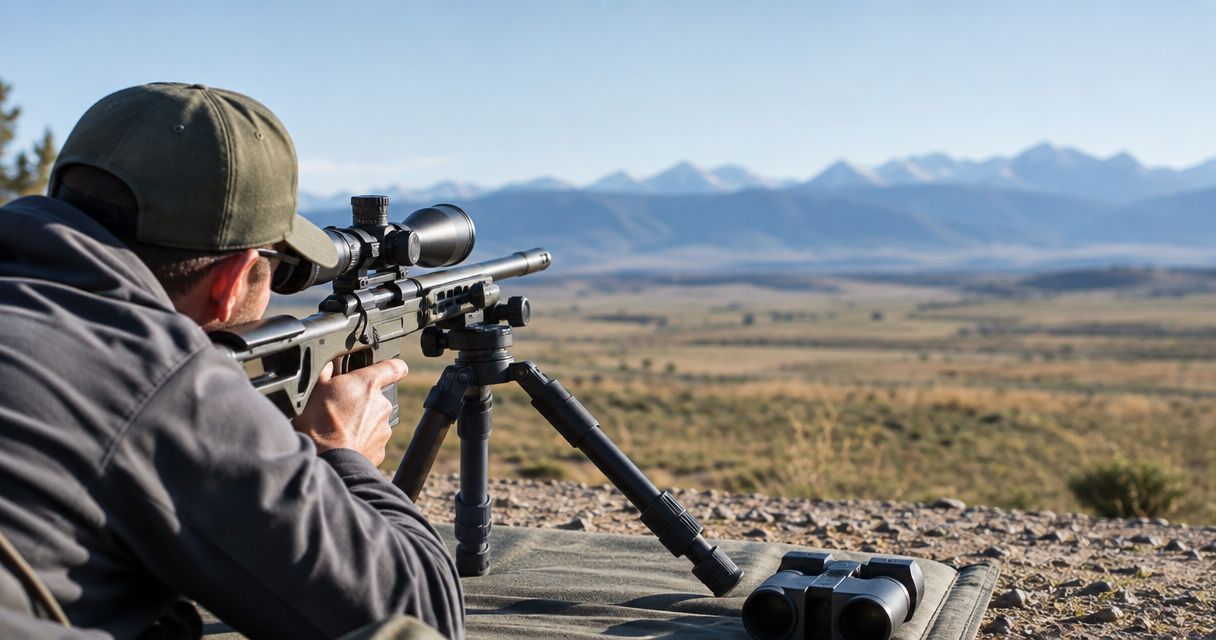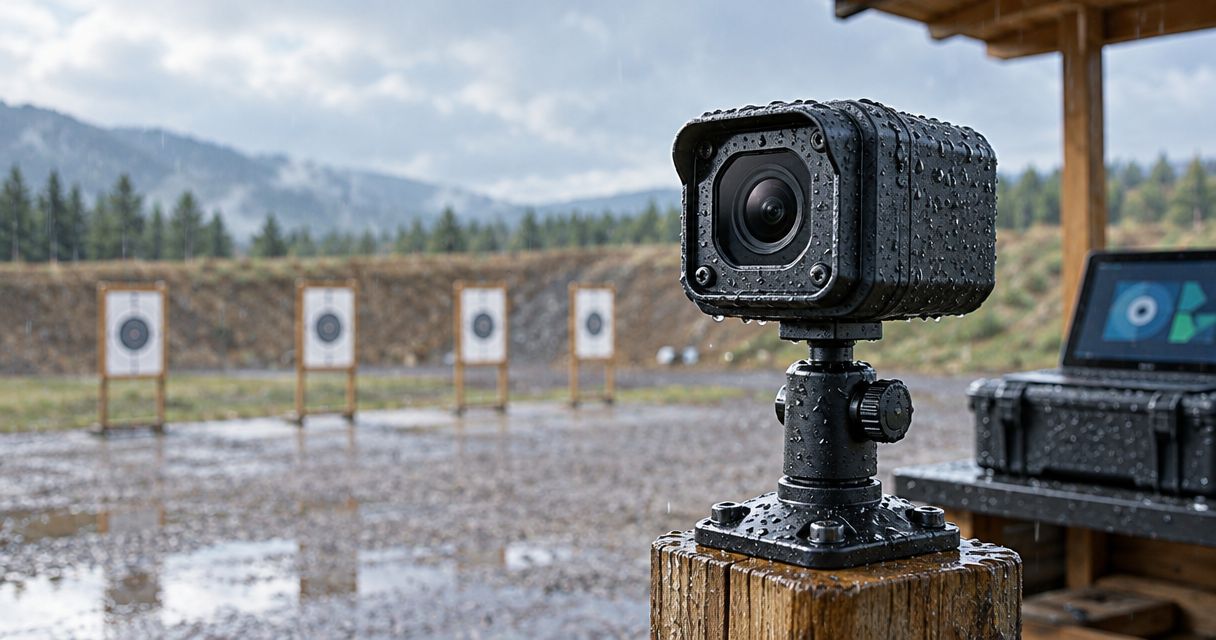
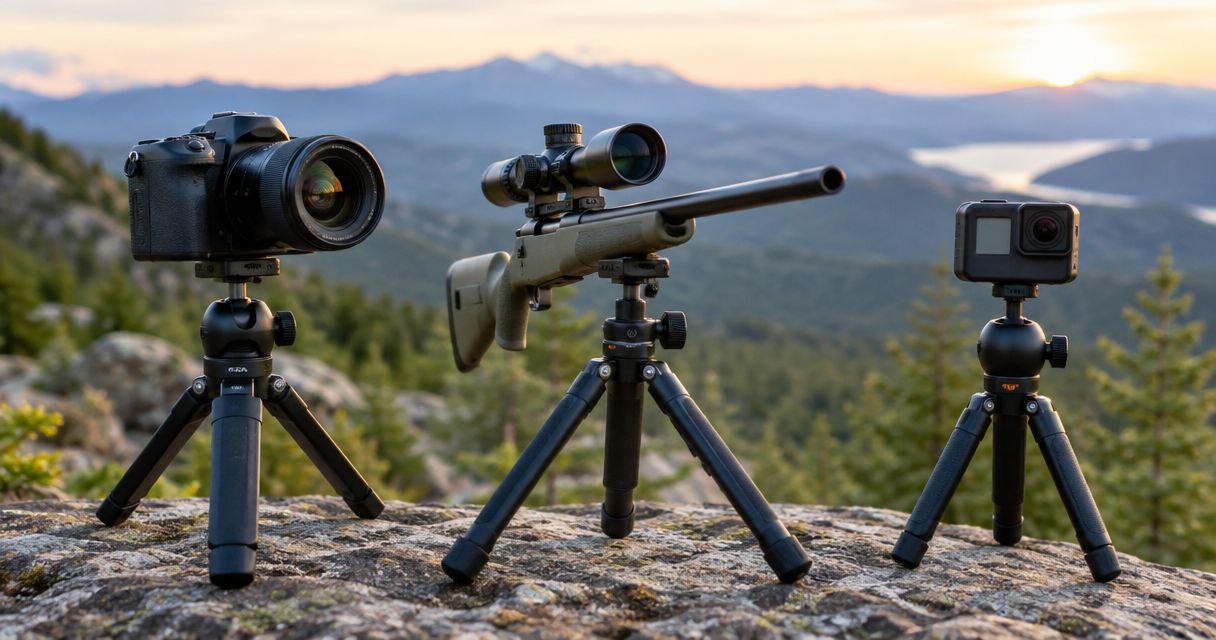
Best overall for target-camera placement: Compact Tripod. Best for adjustable camera framing: an adjustable rigid-leg mini tripod. Best for irregular camera placement: a flexible-leg mini tripod. Best for supporting a rifle: a purpose-built compact rifle tripod. This 2026 guide ranks mini tripods by the job you need them to do, rather than treating camera mounts and firearm supports as interchangeable.
- Compact Tripod is the camera-first pick among mini tripods for a Longshot target-camera setup.
- Adjustable rigid-leg mini tripods suit camera framing when you need separate height and angle adjustments.
- Flexible-leg mini tripods suit irregular camera placement, not direct rifle support.
- Choose a purpose-built compact rifle tripod when the support must hold the firearm itself.
Why this matters
A camera tripod holds an observation device. A rifle tripod supports a firearm and must suit that different job. Buying by folded size alone misses the connection, load, and positioning requirements that determine whether either setup works.
Longshotcameras sells target-camera systems for remotely viewing shot impacts at distances up to 2 miles. That distance describes the camera system, not a tripod capability: the support still needs to keep the camera correctly positioned beside the target.
For your 2026 setup, separate three tasks before choosing equipment: holding the downrange camera, supporting the rifle, and positioning the viewing device at the bench. A small support that handles one task does not automatically handle the others.
What makes the best mini tripods
Judge mini tripods against these criteria before comparing their folded size:
- Intended load: Match the support to a camera, viewing device, or firearm. A photography accessory is not a rifle support merely because the rifle fits above it.
- Mount connection: Check the device socket, tripod screw, and any adapter. A connection must seat correctly without forcing threads or leaving the device loose.
- Footprint: Look for a stance that fits the actual bench or ground surface. Consider the space occupied by fully opened legs, not just the packed dimensions.
- Framing control: Decide whether you need height adjustment, tilt adjustment, or both. Aim the camera without moving the feet into an unsuitable position.
- Locking behavior: Check that the head and legs remain fixed after adjustment. An easy adjustment is useful only if the support holds the chosen position.
- Deployment: Choose a design you can position during the range's permitted setup period. Downrange placement must follow the range's cease-fire and access rules.
Common photographic mounting standards include 1/4-inch screws with 20 threads per inch and 3/8-inch screws with 16 threads per inch. These are category standards, not a compatibility claim for any product in this guide. Confirm the connection on your exact device and support.
Mini tripods at a glance
The 2026 shortlist contains one named camera accessory and three support categories. The category entries help you choose a design without pretending that every model within that design performs identically.
| Item or support type | Best for | Standout feature or purpose | Key limitation |
|---|---|---|---|
| Compact Tripod | Target-camera placement downrange or at the bench | Explicitly described for Longshot camera placement | Camera positioning does not establish suitability for rifle support |
| Adjustable rigid-leg mini tripod | Camera framing that needs height and angle adjustment | Separate positioning controls on suitably equipped models | Additional adjustments mean additional locks to check |
| Flexible-leg mini tripod | Camera placement around an irregular support | Bendable legs change how the camera is positioned | A wrapped setup depends on the supporting surface and attachment |
| Purpose-built compact rifle tripod | Direct firearm support from a low position | A rifle-specific support interface | Rifle fit and shooting-position height require separate checks |
If the rifle needs a larger support rather than a low camera-style stand, use the best tripods for shooting guide to keep the comparison focused on firearm support.
1. Compact Tripod: best mini tripod for target-camera placement
Compact Tripod is described as a support for placing a Longshot camera downrange or providing a steady base at the bench. That stated purpose makes it the strongest match here for a target-camera buyer. Start with the camera's placement requirements, then confirm the connection before ordering.
Compact Tripod is the best fit here for Longshotcameras target-camera users who need a support intended for camera placement. That verdict concerns its stated use, not an assumption that it supports every camera, accessory, or rifle.
Compact Tripod pros:
- Its description explicitly addresses downrange camera placement.
- The same description also identifies bench use.
- Its camera-focused purpose matches the main task in this guide.
Compact Tripod cons:
- A camera-positioning role does not make it a direct rifle support.
- A low placement is unsuitable when surrounding vegetation or target hardware blocks the camera's view.
- Sharing one support between the bench and downrange positions requires repositioning equipment between those jobs.
Best for: A target-camera user choosing a support around the camera rather than around the rifle.
For a 2026 equipment refresh, do not replace a working support just to make the kit smaller. Replace it when the existing support cannot give you a clear view, a dependable connection, or a usable footprint.
Verdict: Buy Compact Tripod for its stated camera-placement role after confirming your mounting requirements.
2. Adjustable rigid-leg mini tripod: best for camera framing control
An adjustable rigid-leg mini tripod is the design to consider when camera height and viewing angle need separate adjustments. Select a model that actually provides the controls you need; the category name alone does not establish them. This option earns its place when a fixed camera position leaves the target poorly framed.
Rigid legs provide a defined stance, while a suitable head lets you change the camera angle. Treat the legs and head as separate parts of the decision. A useful leg arrangement cannot compensate for a head that fails to hold the selected angle.
Adjustable rigid-leg mini tripod pros:
- Adjustable height helps place the camera above a local obstruction.
- A tilting head lets you frame the target without relocating the entire support.
- Independently adjustable legs, when fitted, let you accommodate an uneven surface.
Adjustable rigid-leg mini tripod cons:
- Each adjustable joint adds another lock to inspect.
- Extending the support raises the camera's position and changes its balance.
- A broad stance can conflict with a narrow bench or limited placement area.
Best for: Camera users whose main problem is getting the target into view at the right angle.
Before choosing this design, identify the adjustment that your current setup lacks. If the camera already frames the target correctly, adding more moving parts solves no actual problem.
Verdict: Buy an adjustable rigid-leg mini tripod when height or tilt control is necessary; skip it when a simpler support already works.
3. Flexible-leg mini tripod: best for irregular camera placement
A flexible-leg mini tripod uses bendable legs to change the support shape or wrap around a suitable object. It belongs in a camera-placement kit when a conventional flat stance is awkward. The attachment surface becomes part of the setup, so inspect it as carefully as the tripod.
This design is not a shortcut around range placement rules. Get permission for the mounting location and keep equipment outside the intended projectile path. Never attach a camera to an object simply because its shape makes wrapping the legs convenient.
Flexible-leg mini tripod pros:
- Bendable legs allow positioning around an irregular support.
- The shape can adapt where rigid feet lack a suitable resting surface.
- Camera angle and attachment position can be changed together.
Flexible-leg mini tripod cons:
- The setup depends on the firmness and shape of the object supporting it.
- A wrapped camera position needs checking after the device is attached.
- Flexible camera legs are not a substitute for purpose-built firearm support.
Best for: A camera user with an approved mounting location that does not suit a conventional tripod stance.
For 2026, choose this category because your placement requires it, not because it looks more adaptable in a product photograph. A straightforward ground position is preferable when it already provides the required view and secure support.
Verdict: Buy a flexible-leg mini tripod for a specific camera-placement problem; skip it for direct rifle support.
4. Purpose-built compact rifle tripod: best for direct firearm support
A purpose-built compact rifle tripod holds a firearm through an appropriate cradle, clamp, or mounting interface. That is a different purchase from a target-camera stand. Choose the support around the rifle's approved attachment points and your intended shooting position.
The word compact does not establish whether the support reaches your required height. A low support belongs in a low-position comparison; it should not be treated as an alternative to a taller tripod when your position requires elevation.
Purpose-built compact rifle tripod pros:
- Its support interface is selected for a firearm rather than a camera.
- A suitable low design matches a low shooting position.
- Keeping rifle and camera supports separate lets each remain positioned for its own job.
Purpose-built compact rifle tripod cons:
- Rifle compatibility must be checked independently of tripod size.
- A low support cannot provide the height required by every shooting position.
- It adds a separate support to the equipment you carry and position.
Best for: A shooter who needs the tripod to support the firearm itself, rather than hold a camera observing the target.
Keep the firearm unloaded while fitting or checking equipment, follow its manufacturer's instructions, and maintain safe muzzle direction. Confirm that the support interface does not obstruct controls or require an unsuitable attachment point.
Verdict: Buy a purpose-built compact rifle tripod for firearm support; skip camera mini tripods for that job.
Check the setup before using it
Use this sequence whenever you change a device, mount, or placement location. A support that worked on a bench still needs checking when moved to uneven ground.
- Mount fit: Inspect the connection and attach the device according to its instructions. Do not force a screw that appears close to the correct size.
- Leg placement: Open and position the legs on a firm surface. Check that the complete footprint fits without a foot resting over an edge.
- Lock check: Secure each adjustment, then check that the device remains in position after you remove your hands.
- Clear view: Confirm the camera frames the intended target. Check the image from the viewing position before the permitted setup period ends.
- Range clearance: Follow the range's access rules and return from downrange before firing resumes. A remote image does not replace the range officer's control of the firing line.
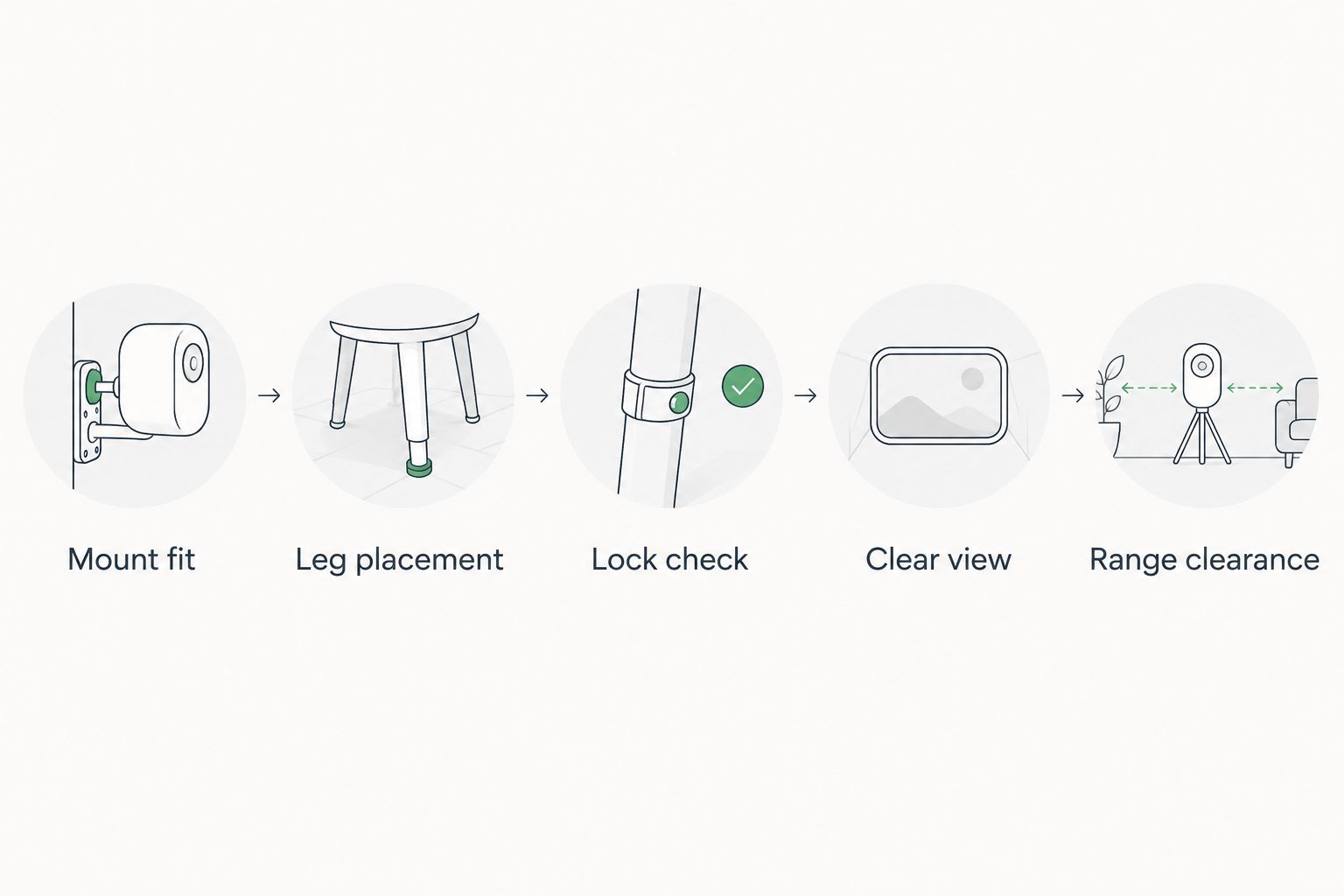
Repeat the checks after moving equipment. Do not assume that a successful connection guarantees a useful camera view, or that a useful view proves the support is secure.
Keep the viewing device separate from the camera support
The downrange camera and the bench-side viewing device have different placement needs. Longshot Tablet Stand (Black) – Target Camera System is described as holding most smart devices and providing two viewing-angle positions. It is a viewing-device accessory, not a substitute for the camera tripod or a rifle support.
Best for: A bench-side viewing device that needs a dedicated stand. Its useful distinction is separation of tasks; its limitation is that a tablet stand does not perform the downrange camera-support job.
These accessories address separate parts of a Longshotcameras target-camera setup. Choose the camera support for the image position and the viewing-device support for where you read that image.


How the mini tripods are ranked
This ranking prioritizes intended load, connection, footprint, framing control, locking behavior, and deployment. Compact Tripod leads the camera shortlist because its stated purpose directly matches target-camera placement. The remaining entries identify designs for distinct jobs rather than claiming measured performance differences between unnamed models.
No category wins every task. Flexible legs solve a placement problem; adjustable rigid legs solve a framing problem; a firearm-specific interface addresses rifle support.
Which mini tripod should you choose?
Choose Compact Tripod as the starting point for a Longshotcameras camera-support purchase. Check the mounting connection and intended placement before committing. Select an adjustable rigid-leg alternative when you need camera positioning controls that your existing support lacks.
Choose flexible legs only for an approved location that requires that design. If the equipment being supported is the rifle, leave the camera shortlist and choose a purpose-built firearm support instead.
The right 2026 choice is the support that performs your actual task with the fewest unnecessary adjustments. Folded size comes after fit, placement, and a secure mounted position.
FAQ
What's the best mini tripod for a target camera?
Compact Tripod is the camera-first pick in this guide because its description explicitly covers Longshot camera placement downrange and at the bench. Confirm the mounting connection and placement requirements for your exact camera.
Can I use a camera mini tripod to support a rifle?
Do not treat a camera mini tripod as a rifle support. Choose a purpose-built firearm support with an interface suitable for your rifle and follow the equipment manufacturer's instructions.
Is a rigid-leg mini tripod better than a flexible-leg tripod?
A rigid-leg mini tripod is the better fit for a conventional stance; flexible legs address irregular camera placement. Choose by the surface and mounting location, not by assuming one design is best everywhere.
Do all mini tripods use the same mounting screw?
No, mini tripods and device mounts do not all use the same connection. Common photographic standards include 1/4-inch screws with 20 threads per inch and 3/8-inch screws with 16 threads per inch; check both components before attaching them.
Where should I put a mini tripod for a target camera?
Place the mini tripod where the camera has a clear target view and the support rests securely, subject to the range's rules. Keep equipment outside the intended projectile path and make downrange adjustments only during permitted access.
Do I need a separate stand for my viewing tablet?
A separate viewing-device stand lets the tablet remain at the bench while the camera support stays downrange. Longshot Tablet Stand (Black) – Target Camera System is described as holding most smart devices and offering two viewing-angle positions.
What should I check before buying mini tripods in 2026?
Check the intended load, mount connection, footprint, framing controls, and locks before buying mini tripods in 2026. Decide first whether you are supporting a camera, a viewing device, or the firearm itself.
One last thing
Evaluate the camera image, not just the tripod's stance. A firmly positioned camera that cannot see the target still fails its job. Finish your setup by checking the view from the position where you will actually observe the impacts.