
A gunshot has no fixed maximum hearing distance: how far it carries depends on the firearm, ammunition, terrain, weather, and background noise. Hearing a report does not reliably tell you how far away the shooter is, and failing to hear one does not establish that an area is safe.
- How far can you hear a gunshot? There is no universal distance; weather, terrain, and background noise change audibility.
- A muzzle blast, bullet crack, and echo are different sounds; none alone gives a dependable shooter distance.
- Longshotcameras target cameras suit shooters who need visual impact feedback, not sound-based guesses.
- Use hearing protection at the range and follow range commands; quiet does not mean safe.
Why this matters
Audibility, hearing risk, and projectile travel are different questions. A shot that sounds distant is not a reliable indication of where the shooter stands, where the firearm points, or where the projectile will stop. Treating those questions as interchangeable creates false confidence.
For your 2026 range planning, separate listening from target observation. If your goal is to see where a shot landed, the guide to sighting in a rifle without walking downrange addresses that task directly. Sound alone cannot show you an impact location.
If you hear unexplained gunfire outside a controlled shooting setting, do not approach it to estimate distance. Move to safety and contact emergency services when there is an immediate threat.
How far can you hear a gunshot?
A gunshot remains audible only while its sound reaches your ears strongly enough to stand out from surrounding noise. There is no single distance that applies to every firearm, landscape, and listener. A quiet setting can reveal a report that traffic or machinery would mask elsewhere.
The comparison below explains why apparently similar shots produce different listening experiences. These are acoustic conditions, not measured hearing-distance bands.
| Listening setting | What helps you hear the shot | What limits interpretation |
|---|---|---|
| Quiet, open ground | Little background noise and an unobstructed sound path | Wind and temperature structure still affect sound propagation |
| Busy roadside | A distinctive impulse can stand out briefly | Traffic masks quieter parts of the report |
| Buildings or rocky terrain | Reflections can make the report conspicuous | Echoes complicate direction and timing |
| Behind a ridge or substantial barrier | Sound can diffract around obstacles | The direct sound path is obstructed |
| Indoors | Reflections can make an impulse prominent | Walls, windows, and room acoustics change what reaches you |
The useful conclusion is not that one setting has a guaranteed radius. A hearing-distance estimate needs conditions attached to it; otherwise, it is not a dependable planning number.
What does sound physics actually tell you?
For an ideal point source spreading sound freely, sound pressure level falls by approximately 6 decibels for each doubling of distance. That relationship describes geometric spreading under ideal conditions. It does not include every effect of ground, obstacles, atmospheric absorption, or weather.
Sound travels at approximately 343 meters per second in air at 20°C. That helps explain why a distant report arrives after a visible event, but it does not turn an unidentified bang into a range measurement. You need a known starting event and a known sound path before timing becomes useful.
For a 2026 assessment of a specific shooting location, use measurements and qualified acoustic advice rather than treating either physics figure as a maximum audible distance. A spreading rule describes a change in level, not the point at which every listener stops hearing.
Why gunshot hearing distance varies
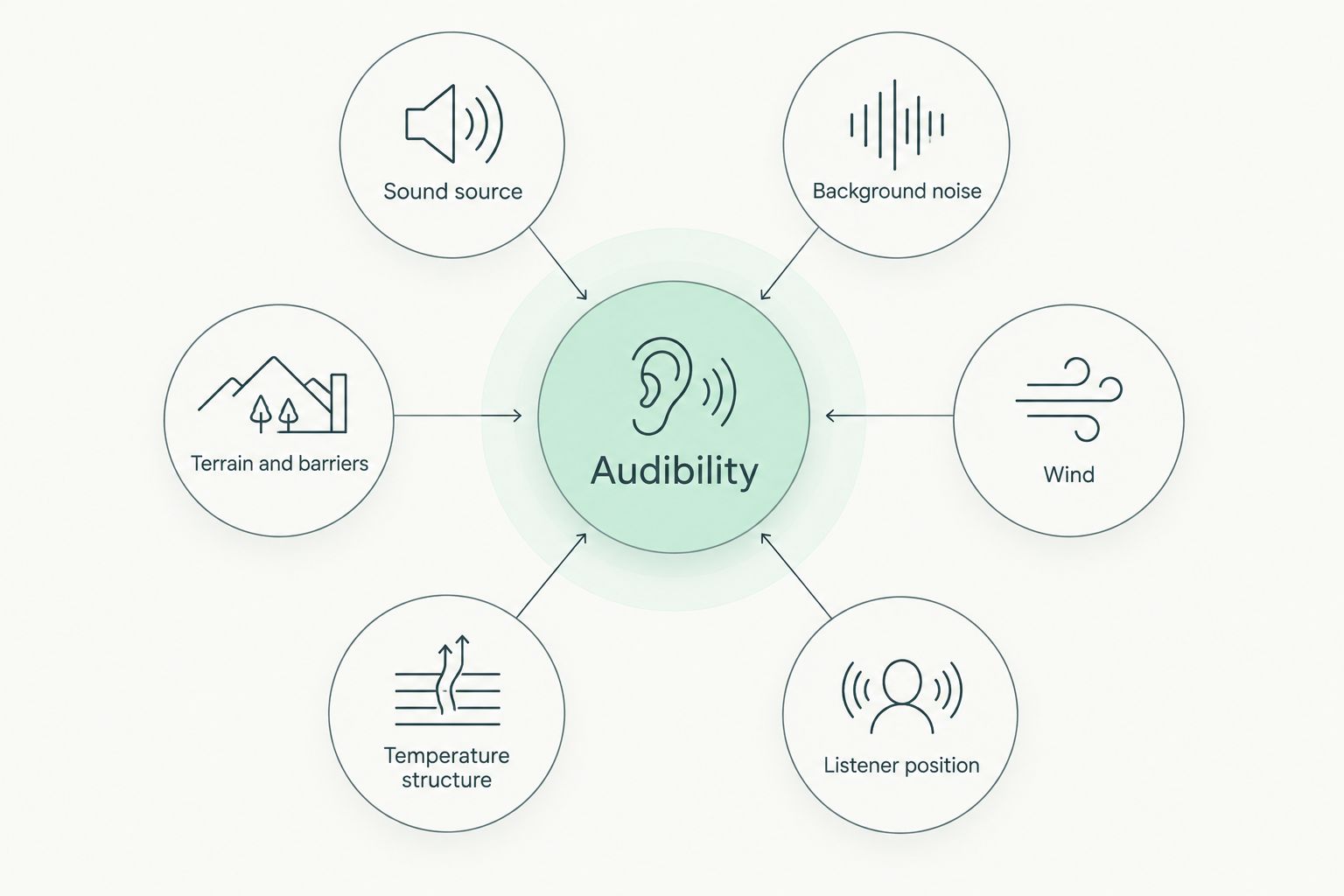
These factors explain why a report can be obvious during one session and harder to distinguish during another. None supplies a standalone distance estimate.
- Sound source: The firearm, ammunition, barrel configuration, and muzzle device affect the sound produced. A generic firearm category does not establish a universal audible range.
- Background noise: Traffic, machinery, wind noise, and other activity can mask a report. Hearing a shot depends partly on how clearly it stands out, not only on its absolute level.
- Terrain and barriers: Ridges, buildings, and substantial obstacles interrupt direct sound paths. Reflected or diffracted sound can still reach you by another route.
- Wind: Wind gradients affect how sound bends through the atmosphere. Conditions between the source and listener matter, not just the breeze at your position.
- Temperature structure: Temperature changes with height affect sound propagation. A temperature inversion can bend sound back toward the ground rather than letting it spread upward.
- Listener position: Your location relative to the muzzle, projectile path, and reflecting surfaces changes what reaches you. Hearing ability and hearing protection also change your listening experience.
A useful way to organize these influences is to separate the source, the path, and the listener. That prevents you from attributing every change in loudness to distance alone.
A weather report is not a substitute for an acoustic survey. It describes conditions, but it does not establish the report level at every neighboring property or listening position.
Why can one gunshot sound like several bangs?
A muzzle blast, a supersonic projectile's shock wave, and reflected sound can reach a listener as separate events. Hearing multiple sharp sounds therefore does not establish that multiple shots were fired. The sound sequence depends on the source and the listener's position.
Do not count shots from echoes alone. Buildings, hillsides, and other reflecting surfaces can make an impulse arrive again after the direct sound. An unfamiliar location gives you no dependable basis for separating those arrivals by ear.
Muzzle blast
Muzzle blast comes from rapidly expanding gases as the projectile leaves the barrel. Its level and character depend on the firearm and ammunition configuration. What sounds sharp nearby can sound less distinct after traveling through the environment.
The advantage of recognizing muzzle blast as a separate source is conceptual: you stop assuming every bang comes from the same point in the sound sequence. The limitation is practical: an unaided listener still cannot reliably identify the firearm or its distance from that sound alone.
Supersonic crack
A projectile traveling faster than the local speed of sound produces a shock wave. A listener positioned to encounter that wave can hear a sharp crack distinct from the muzzle report. Not every listener hears the same sequence.
A projectile below the local speed of sound does not produce that supersonic shock wave. That does not eliminate muzzle blast or make the firearm hearing-safe. A missing crack is not proof of a harmless sound level.
Echoes and reflections
An echo follows a reflected path rather than the direct path from the source. Its apparent direction can point toward a reflecting surface, not toward the shooter. Indoor reverberation can further blur individual arrivals.
The result is an important limit on interpretation: loudness, direction, and the number of bangs can all mislead you. Do not turn those impressions into a claim about an exact shooting position.
Can you estimate gunshot distance by counting seconds?
Sound travels approximately 343 meters per second in air at 20°C, but counting seconds works only when you know when the original event occurred. A visible flash and the sound you hear must belong to the same event for the delay to mean anything.
An unexplained bang gives you no starting timestamp. Echoes add another problem because a reflected arrival has traveled a longer route. A supersonic crack is also not interchangeable with the muzzle report.
For ordinary listeners, the practical answer is straightforward: do not use an unidentified report as a distance-measuring tool. The calculation can be simple while the assumptions behind it are wrong.
Does a suppressor make a gunshot impossible to hear?
A suppressor reduces muzzle blast; it does not guarantee an inaudible shot. Other sounds remain, and a supersonic projectile can still produce a shock wave. The result depends on the firearm, ammunition, suppressor, and listening conditions.
Do not translate reduced report into a guaranteed hearing-safe exposure. NIOSH firearms-noise guidance treats shooting as a hearing-protection concern, and suppressor use does not replace an appropriate protection plan.
For your 2026 equipment decisions, keep sound reduction and hearing protection separate. A quieter configuration changes the source; protection addresses what reaches your ears.
Does hearing distance tell you whether your hearing is at risk?
No. Detecting a distant report and standing near a firearm during discharge are different exposure situations. A sound that is merely noticeable at one location can be hazardous closer to its source.
Protect your hearing whenever you shoot or stand near active shooting. NIOSH guidance on firearm noise recommends double hearing protection for shooters: earplugs with earmuffs. Follow your range's requirements and make sure protection fits correctly.
Comfort is not a sound-level measurement. A report that feels less sharp through protection is not evidence that removing protection is safe, and a brief impulse does not need to feel painful to warrant caution.
Make protection and communication part of your 2026 range checklist. Agree on range commands before firing starts, and do not remove protection during active shooting just to hear a conversation more clearly.
How should you check impacts without relying on sound?
Use visual evidence to answer a visual question. A target image shows the target area; an audible report tells you only that sound reached your position. Even a clear impact sound does not show where on the target the projectile landed.
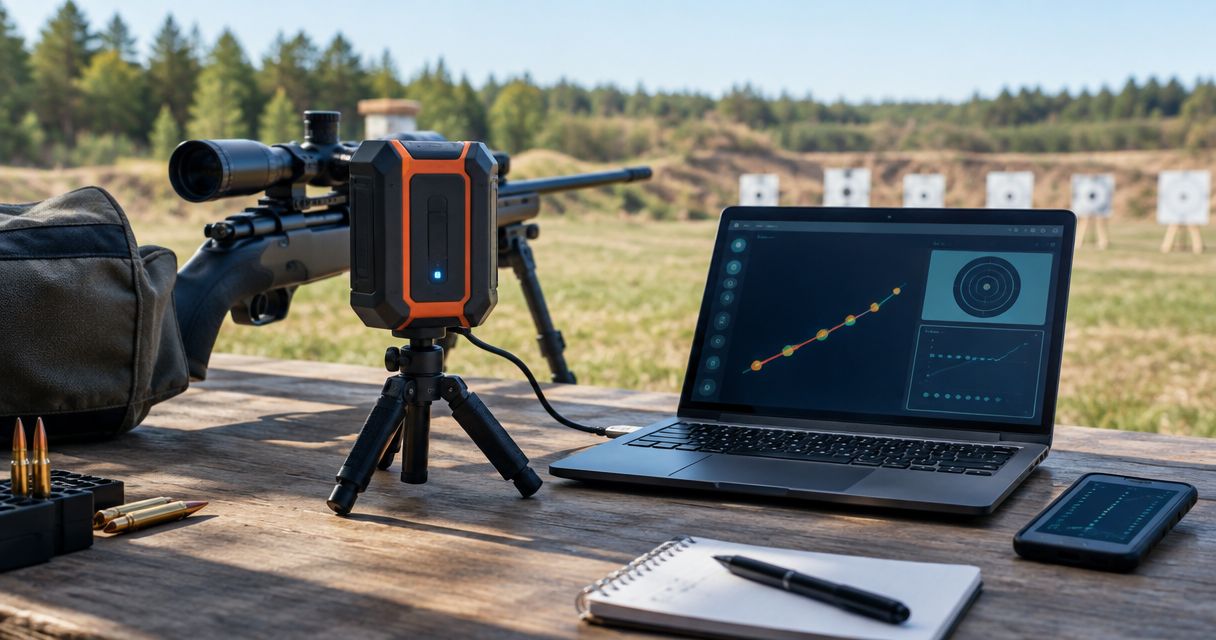
Longshotcameras target cameras are best for shooters who want remote visual feedback on shot impacts. The brand describes camera capability at distances up to 2 miles, allowing shooters to view impacts without walking downrange. That figure describes its stated camera capability, not how far a gunshot carries.
The benefit is remote observation. The limitation is equally important: a camera view does not replace a safe backstop, range supervision, or confirmation that the entire downrange area is clear. Arrange equipment only under the range's approved procedures.
You can review Longshotcameras for target-camera information. For a 2026 setup, choose equipment around the distance and viewing task you actually need, then confirm the relevant model's requirements before use.
FAQ
How far can you hear a gunshot in the countryside?
There is no fixed countryside hearing distance for a gunshot. Low background noise can make a report easier to detect, while terrain, wind, and temperature structure change how sound reaches you.
Can you tell how far away a gunshot is by how loud it sounds?
You cannot reliably determine gunshot distance from loudness alone. Different sources, barriers, weather conditions, and listening positions can produce similar loudness at different distances.
Can you hear a gunshot through walls?
A gunshot can be audible through a wall, but the result depends on the wall, openings, source, and background noise. Hearing a muffled report indoors does not establish the shooter's location or distance.
Why do gunshots sometimes sound louder at night?
Lower background noise and temperature structure can make a gunshot more noticeable at night. Darkness itself does not amplify sound, and nighttime conditions do not guarantee a particular hearing distance.
Can a suppressed gunshot still damage your hearing?
A suppressed gunshot can still present a hearing hazard. Reduced muzzle blast is not proof of safe exposure, so use appropriate hearing protection and follow range requirements.
Does a bullet travel only as far as you can hear the shot?
Projectile travel is not defined by gunshot hearing distance. Audibility describes sound reaching a listener; projectile travel depends on a different set of conditions.
Can a target camera tell me how far away a gunshot came from?
A Longshotcameras target camera is intended for viewing shot impacts remotely, not locating an unknown gunshot by sound. Visual target feedback and acoustic source location are different tasks.
One last thing
A quieter report does not prove a farther-away shooter. Before you interpret a change in sound, consider whether the wind, background noise, listening position, or sound path changed. Those explanations do not require the firearm to have moved at all.
At the range, make decisions from established boundaries, commands, and direct observation—not from how close a shot seems. The most useful answer to this question is a limit on what hearing can tell you, not an unsupported radius on a map.